
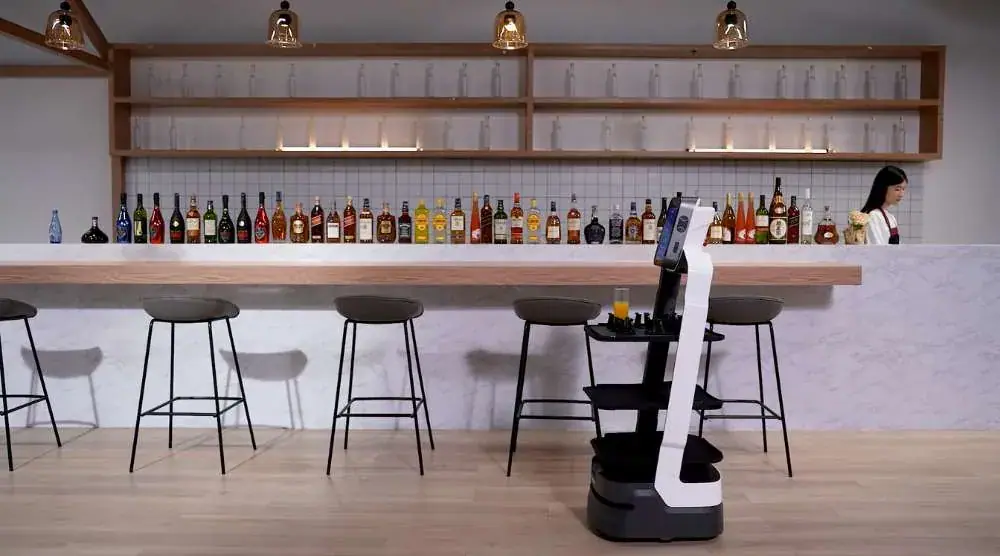
Restaurants across Cyprus are operating in a tight labor market. Seasonal demand spikes hard. Staff turnover remains high. Recruitment takes time. At the same time, guests expect speed and consistency. In this reality, automation is not a trend. It is a strategic decision. The real question is not whether a restaurant robot looks impressive. The real question is whether restaurant robot ROI makes financial sense. Let’s break it down with realistic numbers.
How to Calculate Restaurant Robot ROI
Restaurant robot ROI should be evaluated across three layers:
- Hard savings – direct labor cost reduction
- Operational gains – improved workflow and efficiency
- Revenue impact – better service and higher guest spend
Most owners focus only on wages. That is a mistake. The full return becomes visible when all three factors are considered.

Base Scenario: 50-Seat Restaurant in Cyprus
Let’s model a realistic mid-size venue:
- 50 seats
- 2 waiters per shift
- 6 days per week
- 8-hour shifts
- Average total employment cost: €10 per hour
Now assume the restaurant robot reduces staff workload by ~4 hours per day. This can happen when the robot handles most food running, plate returns, and drink transport during service.
Labor Value Saved
4 hours × 6 days = 24 hours per week
24 hours × €10 = €240 per week
€240 × 4.3 weeks = €1,032 per month
This is direct labor value created by the robot.
Purchase Cost and Payback Period
Assume purchase price: €15,000. Now calculate payback:
€15,000 ÷ €1,032 = approximately 14.5 months
That is just over one year. This is a strong restaurant robot ROI by hospitality standards. Few operational investments recover this quickly.
Hard Savings Explained
Reduced Staffing Pressure
Saving 4 hours per day means you can:
- Eliminate one part-time role
- Shorten shifts
- Reduce overtime
- Avoid emergency hires in peak season
In tourist areas like Limassol, Paphos, or Ayia Napa, this flexibility is critical.
Predictable Labor Costs
A robot does not request days off. It does not resign mid-season. It does not require onboarding. This stability reduces indirect costs that are often ignored in ROI calculations.
Soft Benefits That Strengthen ROI
Hard savings alone justify the investment. Soft benefits accelerate the return.
Better Guest Experience
When waiters are not constantly moving plates, they focus on:
- Upselling
- Personal interaction
- Faster response to requests
If average ticket size increases by even 5%, revenue impact can exceed the labor savings.

Faster Table Turnover
Robots move consistently and efficiently. During peak hours, this reduces delivery time. Faster service improves table rotation, especially in high-demand tourist zones.
Stronger Brand Perception
A restaurant robot positions a venue as modern and forward-thinking. Guests take photos. They share online. Hotels benefit even more, as innovation strengthens premium positioning.
All of these effects improve restaurant robot ROI beyond simple payroll math.
Rental vs Buy: ROI Comparison
Both models exist in Cyprus.
Buying (€15,000)
Advantages:
- Fast ROI (≈14–15 months in this scenario)
- No recurring rental payments
- Long-term cost efficiency
Best for: year-round restaurants and stable operations.
Renting (€700–€900 per month typical range)
Assume €800 per month rental. If the robot generates €1,032 in labor value:
€1,032 – €800 = €232 positive operational margin per month
Even under rental, the robot covers its own cost and creates surplus value. Rental is ideal for:
- Testing the concept
- Seasonal businesses
- Operators who prefer OPEX over CAPEX
Peak Season Scenario: Stronger ROI
Consider a 50-seat restaurant in Ayia Napa during summer. High foot traffic. Two full rotations per evening. Long walking distance between kitchen and terrace.
If the robot replaces most of a seasonal runner:
Runner cost: €10/hour × 8 hours × 26 days = €2,080 per month
Even if the robot replaces only half of that role ≈ €1,040 monthly value
That closely matches our 4-hour-per-day model.
In intense seasonality environments, restaurant robot ROI often falls below 12 months when revenue impact is included.
Does a Restaurant Robot Replace Staff?
No. It replaces repetitive transport tasks. The robot carries. The waiter connects.
The goal is not headcount elimination. The goal is productivity per employee. A smaller, more focused team can deliver better service with the same or lower labor cost.
Where ROI Is Strongest
Restaurant robot ROI performs best in:
- 40+ seat restaurants
- Venues with long kitchen-to-table distance
- Hotels and resorts
- High seasonality locations
- Restaurants struggling with recruitment
In very small cafés, the numbers may not justify the investment. In medium to large venues, they often do.
Common ROI Mistakes
- Ignoring seasonal peaks
- Counting only wage savings
- Forgetting upselling impact
- Failing to evaluate floor layout
The robot must be mapped properly. Workflow matters. Implementation determines results.
Is a Restaurant Robot Worth It? Yes!
With a €15,000 investment and 4 hours of daily labor reduction, payback can occur in about 14–15 months. That is a strong operational return in hospitality.
Add improved service, higher ticket size, and marketing value, and restaurant robot ROI becomes even more attractive. For many Cyprus venues, this is not an experiment. It is a practical operational upgrade.
