
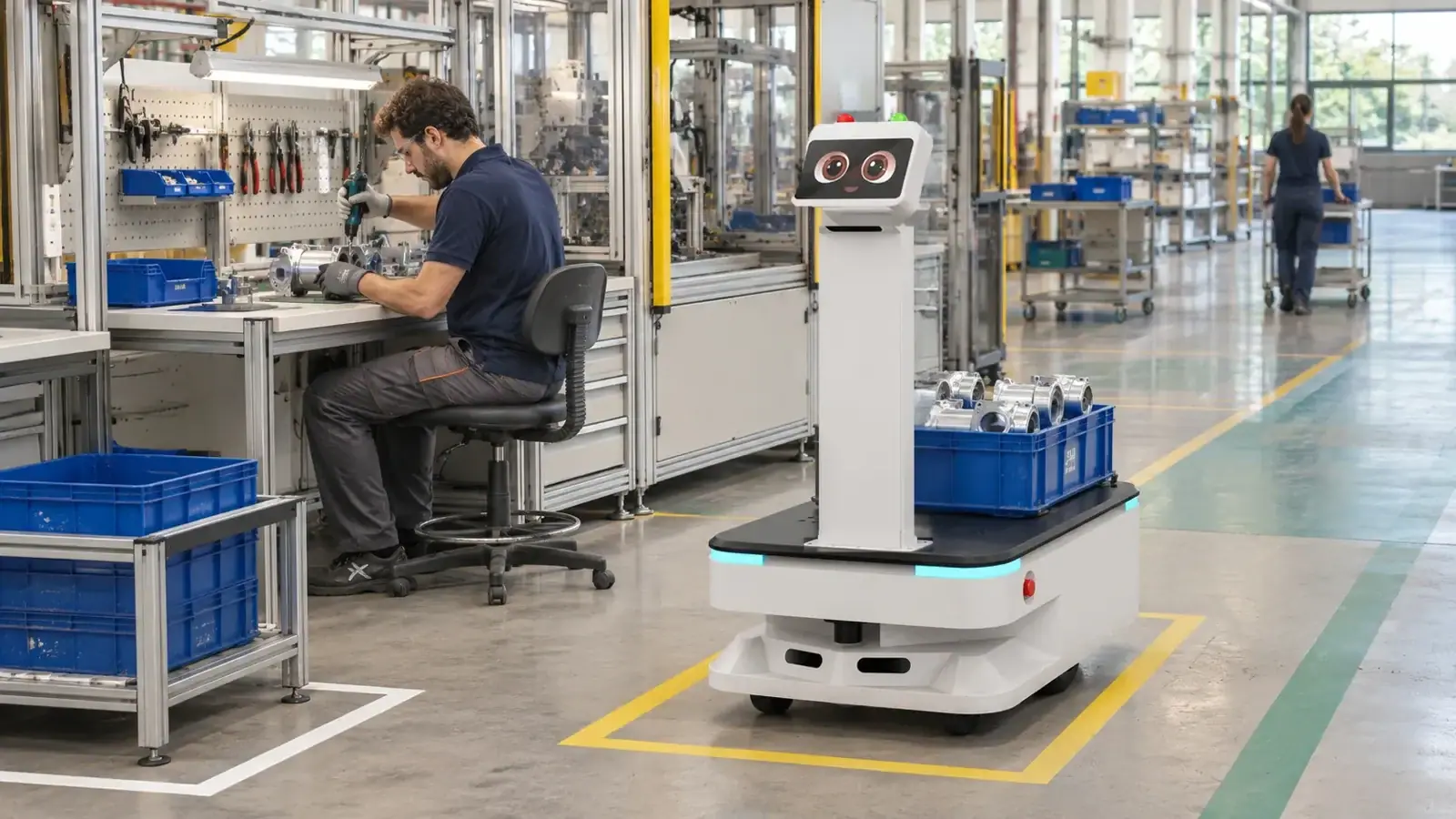
In a factory, a delivery is only useful if it arrives in time for the work that depends on it. A robot can complete many journeys and still be a poor fit if the line waits for components at the critical moment. Selecting equipment therefore begins with production demand, rather than a catalogue of maximum speeds.
A material handling robot can support several parts of the manufacturing cycle: supplying parts, moving work in progress, collecting empty containers or transferring finished goods. The right configuration depends on which of those movements creates the most disruption today.
Define the production problem before choosing a material handling robot
Ask supervisors and operators where transport interrupts the process. Does an assembler leave the station to collect parts? Does a finished load occupy valuable space while waiting for collection? Do empty containers accumulate because returning them is nobody's priority?
Record the trigger for each journey and the latest acceptable delivery time. A replenishment route may run on a regular schedule, while another process needs a request when stock reaches an agreed level. These patterns lead to different requirements for task release and robot availability.
The goal is to give production a dependable service. Maximum carrying capacity matters only after the service requirement is understood.
Match the carrier to the way people work
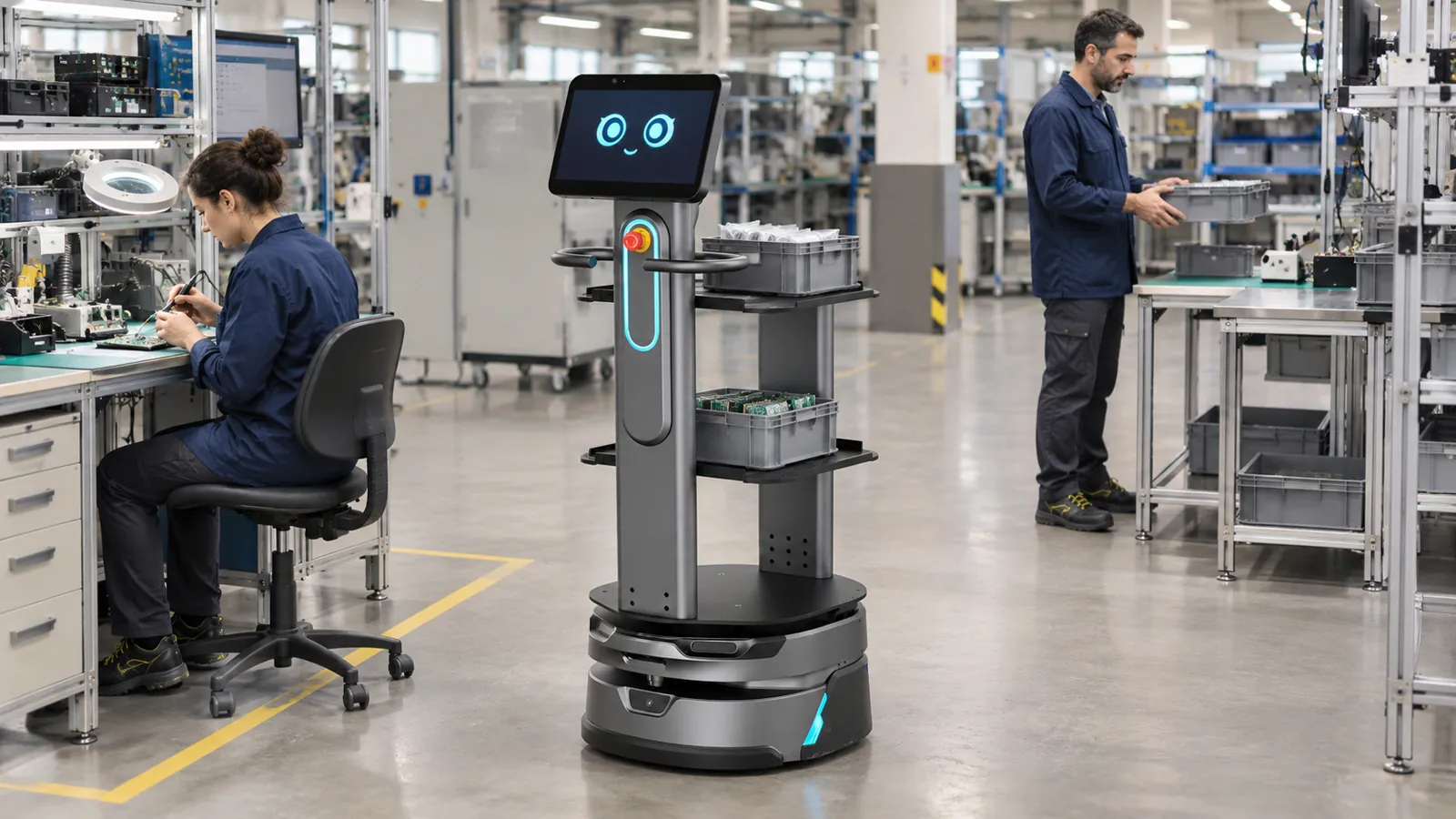
Small component containers can suit a platform or multi-tray robot. OrionStar CarryBot 2 D-150 is worth evaluating when parts for different workstations need to remain separated during transport. Its 30 kg limit per tray must be respected alongside the overall 150 kg limit including trays.
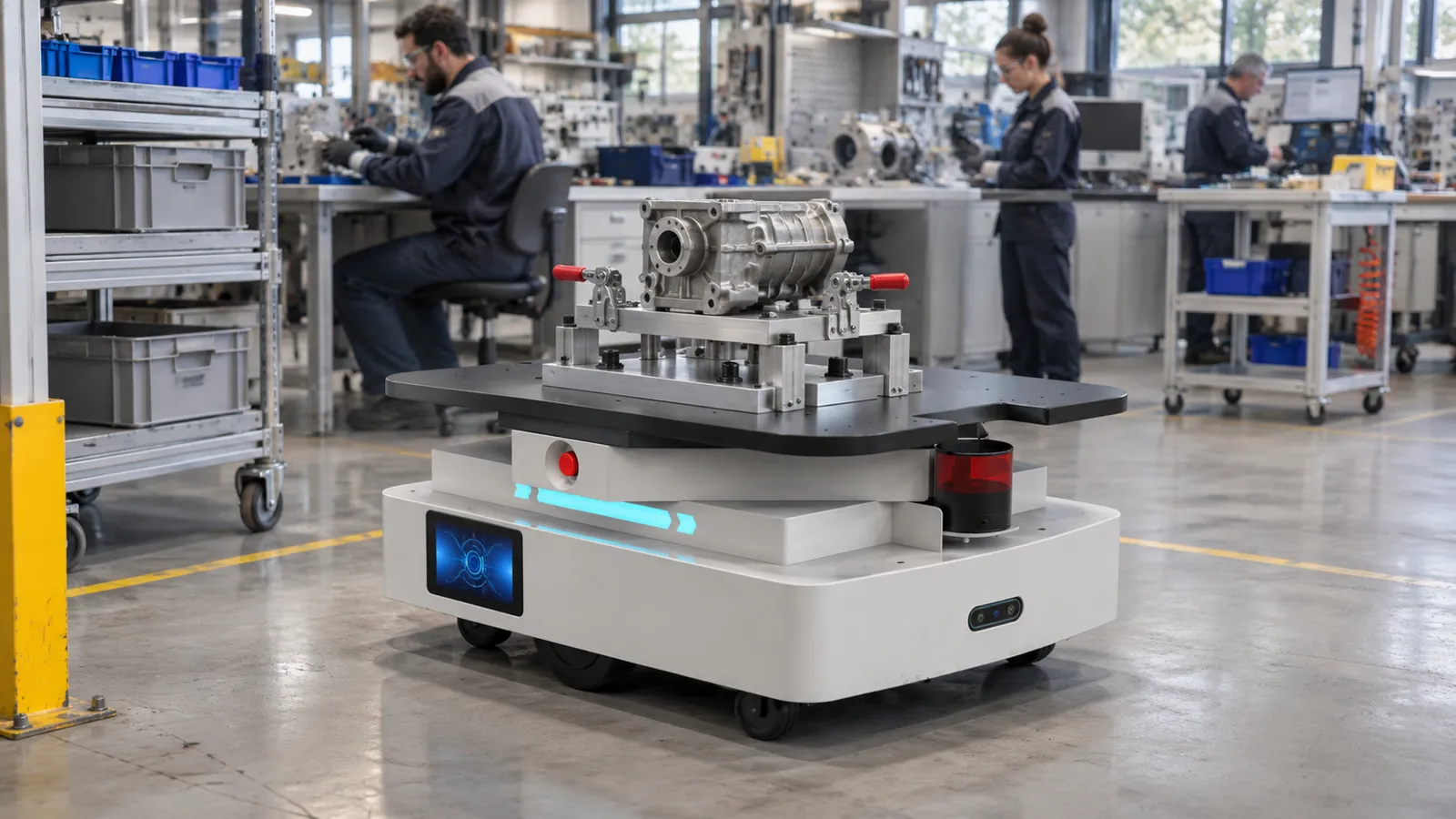
For a production cell that consumes materials from a complete rack, Reeman FlyBoat can lift and move a compatible carrier up to its 300 kg payload. This can avoid unloading a rack onto a trolley merely to move it to another department.
Heavier carriers may call for Reeman IronBov, whose transport and lifting limits are different: up to 600 kg carried and 500 kg lifted. Finished pallets introduce another category. IronHide 2.0 handles low-lift pallet movement, while Rhinoceros supports appropriate elevated placement tasks.
Choose the handling method that removes work from the actual process. A more powerful machine can still be less useful if it creates awkward loading or receiving steps.
Give the line enough time to receive the load
Consider a hypothetical cell consuming one container every 20 minutes. That interval does not mean the robot has exactly 20 minutes available for each round trip. Travel, loading, pickup, handover, other requests and occasional delays all compete for its time.
Determine how much material can wait at the cell without creating congestion. A modest buffer may allow scheduled deliveries; an extremely tight buffer may require quicker response and greater robot availability. Neither is automatically better. The choice depends on floor space, consumption variability and the cost of a missed delivery.
Include return loads in the design. A replenishment process that delivers full containers but leaves staff to move every empty one has automated only part of the work.
Define the information exchanged at each handover
Before integrating software, agree what a task means. At minimum, the system or operator needs to identify the pickup point, destination and readiness of the load. The receiving side needs an agreed way to confirm completion or report that it cannot accept the delivery.
Open APIs can support connections to a warehouse management system or manufacturing execution system. They do not guarantee that either system already has the required connector. Data mapping, task priorities, failed requests and recovery need to be designed and tested.
A pilot can sometimes use a simple employee request while the physical workflow is validated. More extensive integration is easier to specify once the business knows which events genuinely need to be automated.
Test normal production, including the awkward moments
The material handling robot should be evaluated during a representative operating period. Include shared passages, changes of shift, empty-carrier returns and a receiving position that is temporarily occupied.
Measure on-time deliveries, employee interventions and production waiting attributable to transport. Also ask the team whether the robot has reduced their interruptions or merely changed their form. A machine that regularly needs somebody to clear its destination may be completing trips while leaving the underlying problem unresolved.
Operator training should cover task release, loading rules, stopping and the agreed recovery procedure. Any manual or remote driving capability must be confirmed for the chosen model and configuration.
Turn the process into a proposal
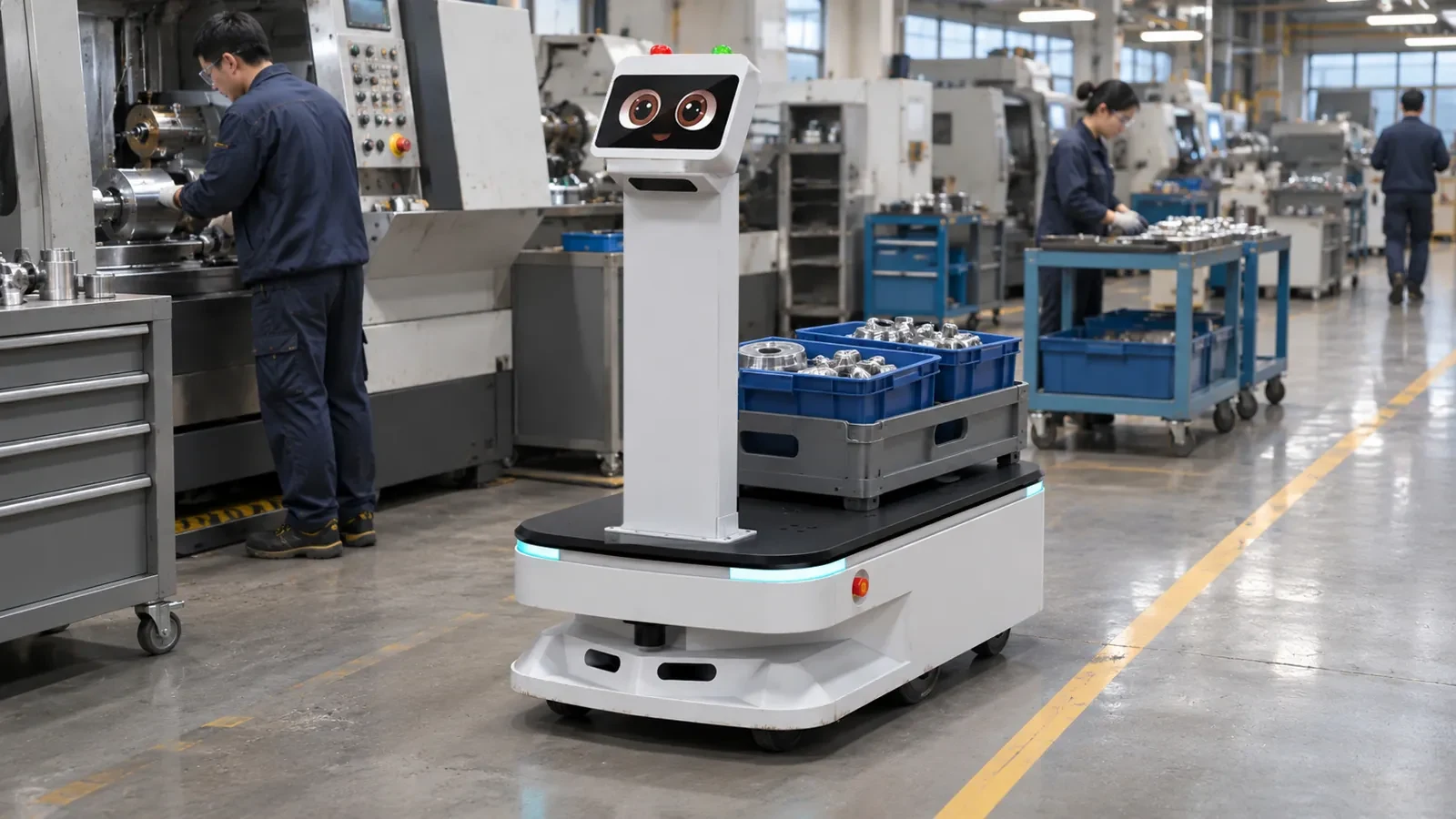
Reef Robotics works with businesses in Cyprus to assess robots for factory material handling against their production requirements. Share the carrier, consumption pattern and handover method, and we can help define a suitable starting scope.
An individual quotation should identify hardware, carriers or attachments, integration, commissioning and training. Prices may change, so build the budget around a confirmed configuration and a measurable production objective.
